AI Implementation in Healthcare: A 90-Day Action Plan
AI implementation in healthcare demands trust and equity, not just speed. Learn the six-pillar framework and 90-day plan. Request a proposal today.

AI implementation is reshaping how hospitals, biotech firms, and public health agencies deliver care, yet most organizations still struggle to move from pilot projects to sustained, trustworthy use. For health systems and life-science companies, AI implementation is not simply a technology rollout; it is a human process that touches patients, clinicians, and entire communities. Therefore, getting it right requires more than good software. It requires governance, equity, and a clear plan. This guide walks through what responsible AI implementation looks like in healthcare, the six-pillar framework behind it, and a practical 90-day action plan your organization can start today.
What Is AI Implementation in Healthcare?
AI implementation in healthcare is the structured process of evaluating, piloting, deploying, and governing artificial intelligence tools inside a health system, biotech company, or research institution so the technology improves outcomes without compromising trust, equity, or safety. It covers data readiness, clinical workflow design, staff training, and community engagement. Done well, AI implementation treats accountability and cultural context as conditions of performance, not afterthoughts.
In practice, this means a diagnostic imaging tool is not just checked for accuracy; it is also checked for whether it performs equally well across different patient populations. Similarly, a scheduling or triage algorithm needs review for how it affects access for underserved communities. As a result, AI implementation sits closer to organizational change management than to a typical IT upgrade. For a deeper look at how equity fits into this process, see this AI equity and ethics assessment guide.
Why Responsible AI Implementation Matters in Health Systems
Many health systems move quickly to adopt artificial intelligence, defined broadly by Wikipedia's overview of artificial intelligence as computer systems performing tasks that typically require human judgment. However, speed without structure often backfires. Industry analysts have repeatedly found that a majority of enterprise AI projects, across industries, stall before reaching full deployment because governance and change management were treated as optional add-ons rather than core requirements.
In healthcare specifically, the stakes are higher. The World Health Organization's 2021 guidance on the ethics and governance of artificial intelligence for health flagged governance gaps as a major obstacle to safe scale-up across its member states. Consequently, organizations that skip governance planning are not just risking a failed pilot; they are risking patient trust. Above all, AI implementation that ignores equity can quietly widen existing health disparities rather than close them.
In contrast, organizations that pair technical review with community engagement tend to see faster staff buy-in and fewer costly reversals. For example, a cancer center that tested a triage algorithm with input from patient advisory groups before launch avoided the kind of backlash that has derailed similar tools elsewhere. For a closer look at measuring these outcomes, review this guide on how to measure ROI for AI opportunity assessments.
The AI4EQUITY™ Framework: Six Pillars for Implementing AI Responsibly
Implementing AI responsibly requires more than a checklist. The AI4EQUITY™ Implementation Framework, built on community-based participatory research and system dynamics, organizes the work into six pillars: Evaluation, Quantify, Understanding, Identity, Translation, and Yield. Each pillar treats trust, accountability, and cultural context as conditions of performance, not optional extras layered on after launch.
- Evaluation: Assess current workflows, data quality, and risk before any tool is selected.
- Quantify: Measure baseline outcomes and equity gaps with real numbers, not assumptions.
- Understanding: Build shared clarity across clinical, technical, and community stakeholders.
- Identity: Account for the cultural context of the populations the tool will affect.
- Translation: Turn findings into governance rules and workflow changes staff can actually follow.
- Yield: Track long-term outcomes, adjusting the approach as evidence accumulates.
Notably, this structure mirrors what bioethics scholars call procedural justice, the idea that how a decision is made matters as much as the outcome itself, a concept well documented in bioethics literature on Wikipedia. Organizations can explore the full methodology directly at MinisterScientist.com.
Cross-functional teams are essential for responsible AI implementation inside health systems.
A 90-Day Action Plan for AI Implementation
A phased, 90-day plan gives organizations a structured way to test AI implementation without overcommitting resources before results are proven. The following five steps map directly onto the AI4EQUITY™ pillars described above.
- Run an equity and readiness assessment (Weeks 1–2): Evaluate data quality, existing workflows, and potential equity risks before selecting any AI tool for implementation.
- Build a governance structure (Weeks 3–4): Form a cross-functional committee with clinical, technical, and community voices to approve use cases and set accountability rules.
- Select and configure a narrow pilot (Weeks 5–8): Choose one well-defined use case, configure it with real workflow data, and document expected outcomes before expanding further.
- Train staff and engage communities (Weeks 9–11): Deliver hands-on training and hold at least one community session so patients understand how the tool affects their care.
- Measure results and decide on scale-up (Weeks 12–13): Track accuracy, equity impact, and staff trust metrics, then use those results to scale, adjust, or pause the initiative.
Similarly, organizations that need help identifying which use case to start with often begin with a formal review. Learn more about what is involved in an AI opportunity assessment before locking in a pilot scope.
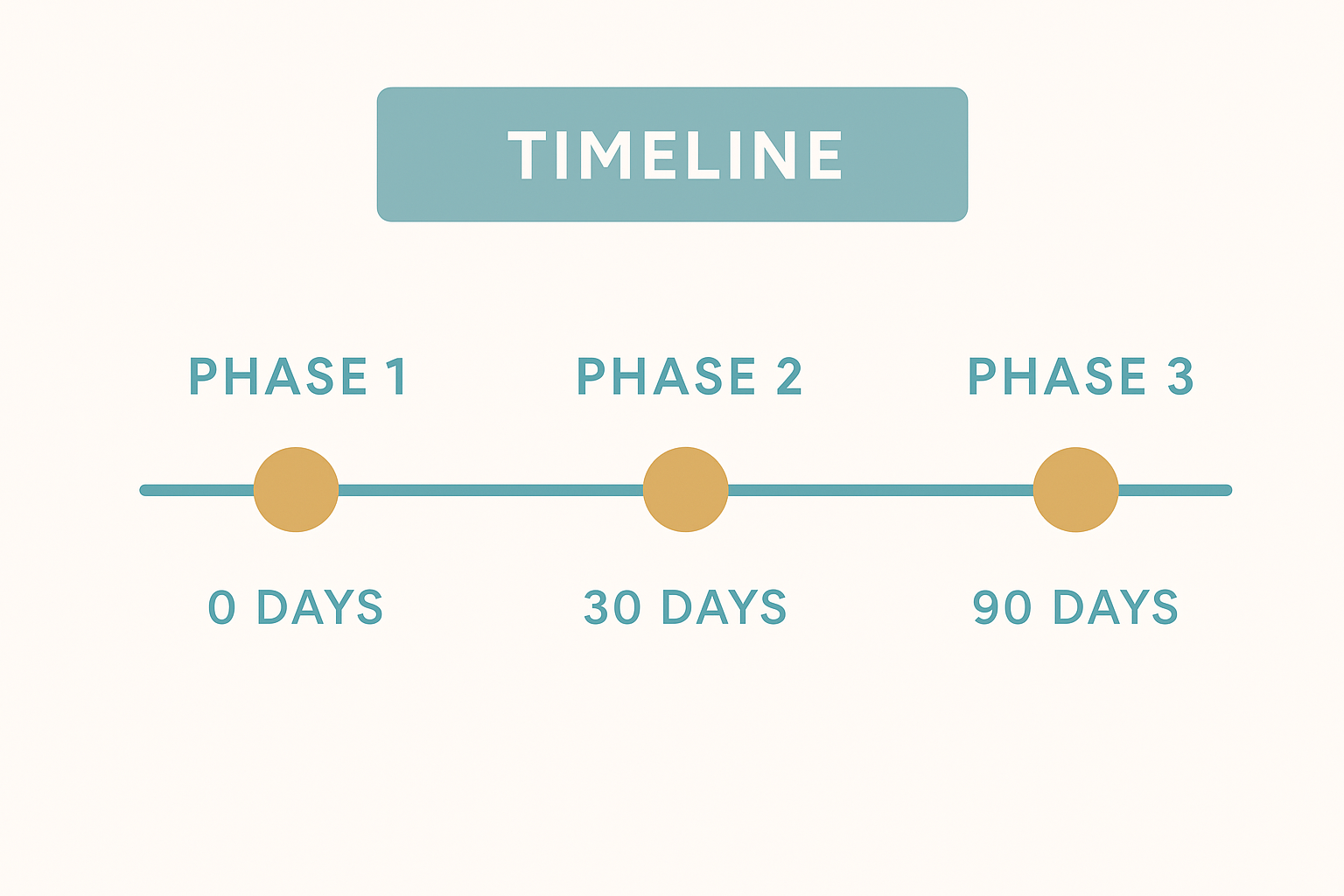
A phased calendar keeps AI implementation measurable and accountable at every stage.
Common Mistakes in AI Adoption Inside Health Systems
Even well-funded AI adoption efforts can stumble. In particular, three mistakes show up repeatedly. First, organizations skip governance planning, assuming vendor assurances are sufficient. Second, they exclude frontline staff from early testing, which breeds resistance later. Third, they measure only accuracy and cost, leaving equity and trust unmeasured until problems surface publicly.
Furthermore, some teams try to implement too many use cases at once, spreading governance attention too thin. Instead, a narrow pilot with clear metrics, paired with an honest governance review such as the one outlined in this guide to developing responsible AI governance frameworks for hospitals, tends to outperform broad, unfocused rollouts.
Who Should Lead AI Implementation Efforts?
Leadership matters as much as methodology. Many health systems lack a single executive accountable for AI implementation, which is why fractional Chief AI/Health Equity Advisor roles have become a practical middle ground between hiring a full-time executive and leaving the function unowned. A fractional advisor can guide governance, vendor review, and equity assessment without the overhead of a permanent hire.
This approach reflects the practitioner background behind the AI4EQUITY™ framework itself, which blends twenty-five years of strategic planning and research administration with a pastoral background focused on human dignity. That combination, technical rigor paired with a deep concern for the people most affected by new systems, shapes how AI implementation recommendations are built. Organizations exploring this model can review fractional advisory services directly.

Community engagement sessions help build trust before AI implementation scales beyond a pilot.
A note on your information: Information you share with this practice — through an inquiry, a book order, a speaking or advisory engagement, or any correspondence — belongs to you. We use it for one purpose only: to serve you well. It is never sold, rented, licensed, or disclosed to third parties for marketing, advertising, resale, or referral. We do not participate in data brokerage of any kind, and we never will.
Frequently Asked Questions About AI Implementation
What is AI implementation in healthcare?
AI implementation in healthcare is the structured process of evaluating, piloting, deploying, and governing artificial intelligence tools so they improve outcomes without compromising trust, equity, or safety. It spans data readiness, workflow design, staff training, and community engagement.
How long does AI implementation typically take in a health system?
A focused pilot can move through assessment and testing in 90 days, but full-scale, enterprise-wide implementation usually takes six to eighteen months. Timelines depend heavily on data infrastructure and governance maturity.
How much does AI implementation cost for a hospital or biotech company?
Costs vary widely based on scope, from a focused opportunity assessment in the low five figures to enterprise transformation roadmaps running into six figures. Budgeting should include governance and training, not just software licensing.
What is the difference between an AI opportunity assessment and AI implementation?
An AI opportunity assessment identifies which use cases are worth pursuing, while AI implementation is the execution phase that deploys, governs, and monitors the chosen solution. Most successful projects complete an assessment first.
What are the most common mistakes organizations make during AI implementation?
The most common mistakes are skipping governance planning, ignoring frontline staff input, and failing to measure equity impact alongside accuracy. These gaps often cause pilots to stall before reaching full deployment.
Who controls and owns patient data during AI implementation?
Patients and the health system typically retain ownership of underlying data, while any vendor should operate under a clear data-use agreement that limits secondary use. This agreement should be documented before any pilot begins.
Will AI implementation replace healthcare jobs?
Most well-governed AI implementation efforts are designed to support clinicians and staff rather than replace them, automating narrow tasks like documentation or triage flagging. Roles tied to repetitive data entry are more likely to shift than disappear entirely.
How do health systems keep staff and communities prepared as AI implementation accelerates?
Ongoing training, transparent communication, and community engagement sessions help staff and patients understand what a new tool does and does not do. Organizations that build this into their 90-day plan see faster, more trusted adoption.
Why is there no consistent policy governing AI implementation across health systems?
Regulation has lagged behind the pace of technology, so most governance today comes from individual institutions rather than uniform national policy. This is why internal governance frameworks matter so much during implementation.
What best practices improve the odds of successful AI implementation?
Successful AI implementation starts with a clear equity assessment, involves frontline staff early, and measures trust and accountability alongside accuracy and cost. Phasing the rollout over 30, 60, and 90 days also reduces risk.
What role does a fractional Chief AI/Health Equity Advisor play in AI implementation?
A fractional advisor provides executive-level oversight of AI implementation without the cost of a full-time hire, guiding governance, equity review, and vendor evaluation. This model fits organizations testing their first few AI initiatives.
How does the AI4EQUITY™ framework support responsible AI implementation?
The AI4EQUITY™ framework guides implementation through six pillars, Evaluation, Quantify, Understanding, Identity, Translation, and Yield, so trust and cultural context are treated as performance conditions. It is grounded in community-based participatory research and system dynamics.
Final Thoughts on Responsible AI Implementation
In the end, AI implementation succeeds or fails based on decisions made long before any software goes live. Health systems, biotech firms, and academic medical centers that treat trust, accountability, and cultural context as conditions of performance, not afterthoughts, consistently see smoother pilots and more durable results. A 90-day plan grounded in the AI4EQUITY™ framework gives teams a concrete, measurable way to move forward without losing sight of the people AI implementation is meant to serve. Organizations ready to take the next step can request a proposal to build a 90-day action plan tailored to their own health system or life-science organization.
